Reviewed · TOURS IN NAIROBI
9 Day Private Luxury Spectacle Safari Majestic Kenya Wonderland
Tsavo’s red-dust elephants, Amboseli’s Mount Kilimanjaro views, and the Masai Mara’s big cats give this nine-day safari a strong sweep through Kenya’s best-known wildlife country. I like the private format, since your group can work directly with one guide instead of adjusting to strangers. I also like the range of habitats, from Mzima Springs and volcanic hills to papyrus-fringed lakes and open Mara plains.
The tradeoff is time on the road. Several days run about 10 hours, and the final morning still includes a sunrise game drive before the drive back to Nairobi. At $5,050 per person, this is a serious spend, so you should confirm the exact lodges, vehicle, and inclusions before paying.
Key points to know before booking
- Tsavo West brings variety early: Mzima Springs, red elephants, Roaring Rocks, Poacher’s Lookout, and Chaimu Crater all add more than standard game drives.
- Amboseli is the elephant and Kilimanjaro stop: Early starts give you the best chance of seeing the mountain before clouds gather.
- Lake Naivasha changes the pace: Expect birdlife, papyrus, hippos, and a freshwater lake rather than a conventional safari drive.
- Lake Nakuru adds rhinos and birds: The park is known for black and white rhinos, flamingos, and an afternoon game drive.
- The Masai Mara gets two major wildlife days: A long game drive and a final sunrise outing give you useful time in Big Five country.
- The private setup is a real advantage: Only your group participates, with guides such as Tom, Sebastian, Dickson, Kevin, Michael, and Wycliffe named in past trip accounts.
Why this nine-day route works
This journey packs four very different wildlife areas into one circuit from Nairobi. You begin in Tsavo West, move through Amboseli, cross the Rift Valley lakes, and finish in the Masai Mara. That gives you more variety than a trip that stays in one reserve, but it also means several long transfer days.
I like the route because each stop has a clear purpose. Tsavo supplies volcanic scenery and its famous red-coated elephants. Amboseli is the classic place for elephant viewing with Mount Kilimanjaro in the background. Naivasha brings water and birdlife, Nakuru adds rhinos, and the Mara provides the strongest concentration of large predators.
This is a private safari, not a shared departure. That matters on a long trip. You can ask your guide to spend more time with elephants, birds, or cats, and you do not have to wait for a larger group at every stop. Past guide names connected with this experience include Tom, Sebastian, Dickson, Kevin, Michael, and Wycliffe. The quality of your trip will depend heavily on who is assigned, so ask for the guide’s name and experience before departure.
A few more things to do around Nairobi worth a look
- Hell’s Gate National Park Private Bike Tour from Nairobi
★ 5.0 · 192 reviews - 3 days Masai Mara on Private 4×4 Land Cruiser
★ 5.0 · 130 reviews - Safe and Private Airport transfer in Nairobi
★ 5.0 · 76 reviews
Days 1 and 2: Tsavo West and the red elephants
The first morning begins with a departure from Nairobi at about 8:00 AM. You aim to reach Tsavo West for lunch, followed by an optional afternoon or evening game drive. The drive from Nairobi takes much of the day, so do not picture a relaxed morning followed by endless park time. The appeal is that you reach one of Kenya’s most scenic parks at the start of the trip rather than treating it as a quick add-on.
Tsavo West is known for elephants stained red by the park’s iron-rich soil. You may also see lions, giraffes, zebras, and antelope. The park has more to offer than animals, and Mzima Springs is the main example. Cool, clear water rises through porous volcanic rock, with the source linked to an underground flow from the Chyulu Hills.
On Day 2, you spend a full day on safari with a picnic lunch. Roaring Rocks offers a high viewpoint over Tsavo, while Poacher’s Lookout gives another broad view from a hill near the park’s center. Chaimu Crater, a young volcanic cone made of black cinder, adds a geological stop and can be climbed.
This is a good opening because it mixes wildlife, water, rock, and views. You might find the first two days physically tiring, though. The program calls for roughly eight hours on the first day and 10 hours on the second, with much of that time spent moving between Nairobi, the lodge, and park areas.
Days 3 and 4: Amboseli’s elephants beneath Kilimanjaro
After breakfast on Day 3, you take an early game drive and continue to Amboseli National Park. After lunch and check-in, an afternoon game drive introduces a very different setting. Much of Amboseli lies on a dry former lake bed with open grassland and acacia woodland. Small volcanic hills appear in the southern part of the park, while swamps around Ol Okenya, Ol Tukai, and Enkongo Narok support greener vegetation.
The park’s signature sight is the elephant. Herds feed and bathe around the swamps, and the open setting can make them easier to watch than animals in thick woodland. The famous mountain is Mount Kilimanjaro, just across the border in Tanzania. The mountain is often hidden by cloud, so the early start on Day 4 is not a minor detail. Get out early, when the summit has its best chance of showing itself.
Day 4 centers on another early game drive and close elephant viewing. After breakfast, you can arrange an optional visit to a Maasai village. The program describes singing, dancing, homes, and social structure. Treat this as a chance to learn about local life, while also remembering that village visits are organized encounters, not a substitute for independent community contact.
Amboseli is one of the strongest parts of the route for photographers. The combination of elephants, palms, swamp water, dry plains, and a possible Kilimanjaro backdrop gives you visual variety without needing to chase a particular animal. The main caution is that the mountain is never guaranteed. Clouds can cover it even when wildlife viewing is excellent.
Day 5: Lake Naivasha and a quieter change of pace
Day 5 sends you toward Lake Naivasha, at about 1,910 meters above sea level. This is Kenya’s highest and one of its most scenic Rift Valley lakes. Dense papyrus lines parts of the shore, giving kingfishers a place to perch and herons cover for hunting.
More than 400 bird species have been recorded around the lake. That number gives the stop real value for birdwatchers, but even casual wildlife fans will notice the change from dusty game tracks to open water and shoreline vegetation. Hippos live in the lake, while crocodiles are absent because the water is too cold for them at this altitude.
The lake is also a recreation spot for people from Nairobi, with sailing, water skiing, and fishing. Vineyards grow near the shore for Kenya’s small wine industry. These details make Naivasha feel less like a single-purpose wildlife stop and more like a glimpse of how the Rift Valley is used.
You stay at a resort, and this day includes the tour’s listed admission ticket. The schedule still runs to about 10 hours, largely because of the transfer from Amboseli. If you want a slow, restful holiday, this route may feel too tightly packed. If you like seeing how Kenya changes from park to park, Naivasha earns its place.
Same base, a completely different sort of day:
- Nairobi National Park Half-Day Tour; Free Wi-Fi connection
★ 5.0 · 878 reviews - Nairobi: National Park & Optional Elephants & Giraffe Center
★ 4.8 · 874 reviews - NAI NAMI: Nairobi Storytelling Tour with Street Children
★ 5.0 · 792 reviews - Nairobi National Park Half-Day Game Drive
★ 4.5 · 738 reviews
Day 6: Lake Nakuru for flamingos and rhinos
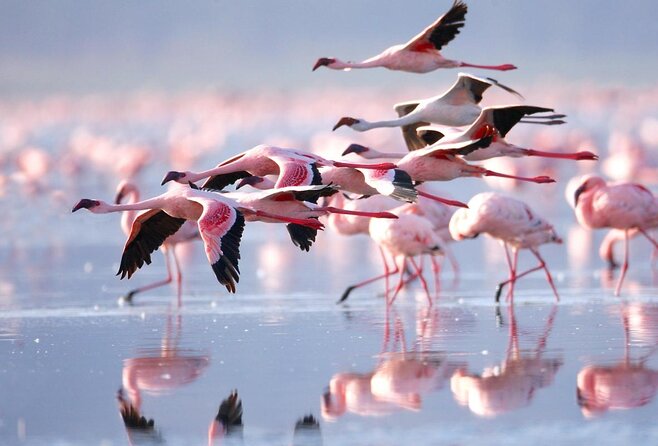
The next stop is Lake Nakuru National Park, south of Lake Bogoria and across the equator. Nakuru is famous for its alkaline lake and flamingos. At certain times, almost two million flamingos can gather along the shore, forming a broad pink band. Numbers shift with water conditions and food supply, so treat that spectacle as a possibility, not a promise.
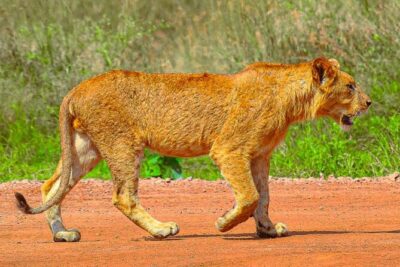
Nakuru also serves as a rhino sanctuary. The stated population includes more than 40 black rhinos and more than 60 white rhinos. That gives the park a different focus from Amboseli, where elephants are the main attraction, and the Mara, where predators and broad wildlife sightings take center stage.
You arrive for lunch and take an afternoon game drive. That timing is practical, but it gives you less park time than a full-day visit. The 10-hour day includes the transfer and the drive, so you should not assume the entire period is spent watching animals.
Still, Nakuru is a useful middle section in the trip. It adds birds, rhinos, and a strongly recognizable Rift Valley setting before you reach the Mara. The experience is strongest for anyone who wants more than the Big Five checklist.
Days 7 and 8: The Masai Mara finale
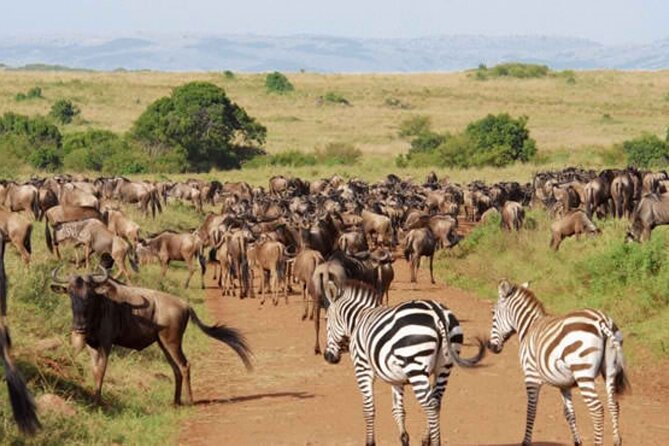
Day 7 begins with an early game drive before the drive to the Masai Mara National Reserve. You aim to arrive for lunch and then take an afternoon game drive. The Mara forms the northern end of the Serengeti ecosystem and is known for large numbers of wildebeest, zebras, predators, and other plains animals.
The famous seasonal migration may be present depending on your dates. The route describes the movement of many thousands of wildebeest, zebras, and predators, but no migration sighting should be treated as guaranteed. The Mara remains worthwhile outside migration season because of its resident wildlife and open setting.
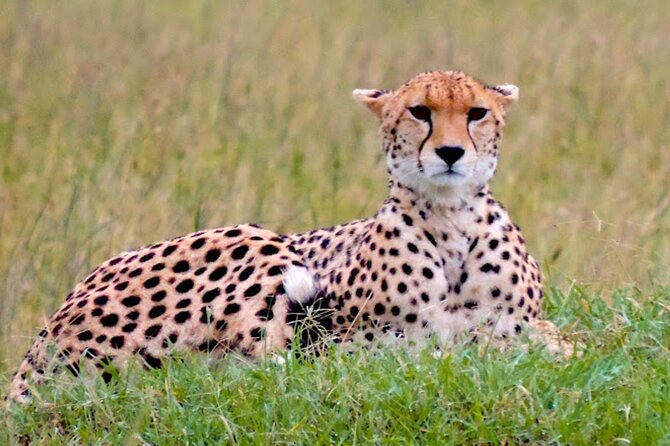
Day 8 is the trip’s main full safari day. After breakfast, you spend the day in the reserve with a picnic lunch. The area is noted for black-maned lions, cheetahs, and the possibility of seeing the Big Five during a morning drive. The description of unusually relaxed cheetahs should not lead you to expect tame animals. Wildlife behavior changes, and your guide must keep a safe distance.
Birdlife is strong here too, with nearly 500 recorded species. The list includes eagles, hawks, falcons, vultures, storks, and bustards. If you enjoy birds, tell your guide early. A private vehicle gives you a better chance of spending time on smaller sightings instead of rushing toward only lions and elephants.
The Mara is the right place to finish because you get a full day after the transfer. Two game drives, plus the final sunrise outing, provide more useful time than a single afternoon stop. The cost is the long journey to reach it and the possibility that roads and park tracks make the days dusty and tiring.
Day 9: Sunrise before the return to Nairobi
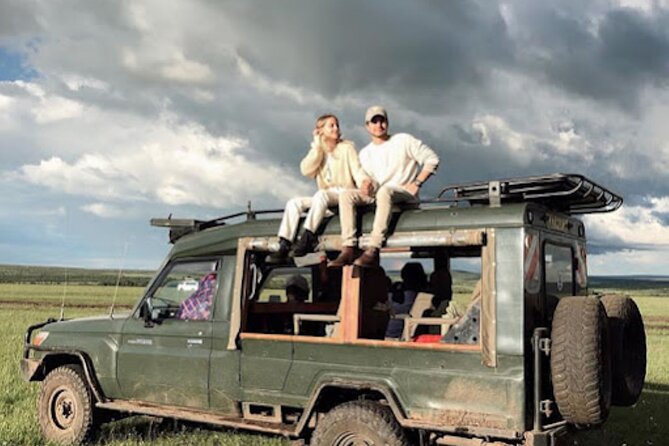
The final morning starts with a sunrise game drive, followed by breakfast, check-out, and the drive to Nairobi with a picnic lunch. You can be dropped at a city hotel or Jomo Kenyatta International Airport.
This arrangement works best if your flight or hotel plans allow flexibility. The program lists about five hours for the final day, but game drives and road conditions can affect the timing. Do not schedule a tight international connection without confirming the expected arrival time directly with the operator.
A final sunrise outing is a smart choice. It gives you one more chance to see animals when temperatures are cooler and many species are active. It also means the trip does not end with breakfast and a straight drive out of the Mara.
Is $5,050 per person good value?
At $5,050 per person, this is priced as a private luxury safari, not a budget park circuit. The value comes from the number of major areas covered, private participation, lodge accommodation, game drives, picnic lunches on long safari days, and the ability to work with one guide throughout.
The price is harder to judge without the exact lodge names, vehicle type, room category, park fees, meals, and airport transfers spelled out. Before booking, ask for a day-by-day cost sheet. Confirm which admissions are included, since the schedule specifically marks some park visits as included while other entries are listed as free.
I would also ask how the luxury label is being applied. The information provided confirms lodge and resort stays, but it does not name the properties or describe room standards. A high price does not automatically mean the same level of comfort at every stop.
The private format adds real value for couples, families, and photographers. It also makes the trip more personal if you are matched with a strong guide. Past guide accounts identify Tom, Sebastian, Dickson, Kevin, Michael, and Wycliffe, with praise for prompt planning, safe driving, animal spotting, and attentive service. One serious account describes disagreements over hotels and shortened safari time, so written confirmation of every promise matters.
Practical fit, timing, and booking cautions
This safari suits you if you want a broad first visit to Kenya and prefer a private vehicle over a shared group. It also suits families and couples who want a planned route, lodge stays, and several chances to see major animals without arranging each transfer themselves.
You should be comfortable with early mornings, long drives, picnic lunches, and about 10-hour days. Most participants can take part, and the experience is near public transportation, with pickup offered. The meeting window is listed as 7:00 to 7:30 AM, Monday through Sunday, during the stated operating period from November 21, 2023 to June 17, 2026.
The activity is confirmed at booking and uses a mobile ticket. Only your own group participates. Cancellation is strict: the experience is non-refundable and cannot be changed for any reason, so do not pay until your dates, lodging expectations, and airport plans are settled.
Should you book this Kenya safari?
I would book it if you want maximum park variety in nine days, especially if Amboseli elephants, Rift Valley lakes, rhinos, and the Masai Mara all matter to you. The route is ambitious, and the private setup gives it a personal feel that a shared bus trip cannot match.
I would pause if you want slow mornings, short transfers, or guaranteed luxury properties. Ask for the exact lodges, vehicle details, guide assignment, included fees, and final-day arrival estimate in writing. If those answers match your expectations, $5,050 can make sense for a private sweep through Kenya’s headline wildlife areas. If not, compare a shorter route with more nights in fewer parks.
FAQ
How long is the safari?
The experience lasts approximately nine days, with accommodation arranged for the overnight stops along the route.
Which parks and areas are included?
The route includes Tsavo West National Park, Amboseli National Park, Lake Naivasha, Lake Nakuru National Park, the Masai Mara National Reserve, and Nairobi for the final drop-off.
Is this a private safari?
Yes. Only your group participates in the activity.
Is pickup offered?
Yes, pickup is offered. The meeting information lists an opening window from 7:00 to 7:30 AM, Monday through Sunday.
Can I be dropped at Nairobi airport?
Yes. On Day 9, drop-off is available at a Nairobi city hotel or Jomo Kenyatta International Airport.
Can I cancel or change the booking?
No. The experience is non-refundable and cannot be changed for any reason.
Just added around Nairobi
- Visit kibera Slum the chocolate city★ 4.8 · 3 reviews
- 3 days maasai mara migration safari★ 4.5 · 7 reviews
- 4 Days Tour Landcruiser in Masai Mara and Lake Nakuru★ 5.0 · 10 reviews
- 4 Days Safari to Lake Nakuru N/P and Maasai Mara N/R★ 5.0 · 18 reviews
- Maasai Mara Day Trip★ 5.0 · 15 reviews
- Day Tour to Nairobi national park, Elephants, and Giraffe Center★ 3.5 · 8 reviews
- Wildebeest Migration in Masai Mara and Sightseeing 4 Days Tour★ 4.5 · 6 reviews
- Vegans special safari★ 4.5 · 4 reviews
Tours in Nairobi, compared.
Nairobi National Park Half-Day Tour; Free Wi-Fi connection
Read our review →
National Park & Optional Elephants & Giraffe Center
Read our review →
NAI NAMI: Nairobi Storytelling Tour with Street Children
Read our review →