

Reviewed · CULTURAL VILLAGE VISITS
Kibera Slum Tour with a Local
Kibera is not a sightseeing backdrop. It is home to a large, hardworking community, and this three-hour walk gives you a direct introduction through guides who were born, raised, and still live there. Erick and Sammy are among the local guides involved, and their personal connection helps you meet the area with more context and less guesswork.
I like two things right away: the money has a clear purpose, with 50 percent of the booking fee going toward school fees for children in the community, and the visit is built around local access, including a craft center, home visit, and time with residents. The main consideration is that a visit to Kibera can feel confronting, so you should book it to listen and learn, not to collect dramatic photographs.
Key points at a glance
- Half of the $25 fee supports school fees for children in need through the local community work connected to the tour.
- Guides are Kibera residents, including Erick and Sammy, with first-hand knowledge of daily life in the area.
- Five stops shape the visit, including the office, a recycling craft center, a local home, and a cafeteria.
- A home visit adds a personal note, but you should approach it with courtesy and respect.
- The tour lasts about three hours, starts and ends at Prestige Plaza Shopping Mall on Ngong Road, and accepts mobile tickets.
- The group can include up to 30 people, although the guides say they can adjust the experience around your interests.
Why a local guide changes the visit

Kibera is often reduced to a single label. That does not tell you much about the people who live there, work there, raise families there, or build community projects there. A local guide can explain what you are seeing in ordinary human terms.
The four guides behind this experience were born and raised in Kibera and still live there. That matters. You are not being led by someone who only knows a few prepared facts. You are meeting people with a personal stake in how their community is understood.
Erick and Sammy are named among the guides connected with the tour. Their role is not simply to point out buildings. You can expect them to discuss daily life, local income, community challenges, and the efforts being made to help children who need support with school costs.
I also like the tone suggested by the visit. The guides are described as open about the difficulties of life in Kibera while still showing compassion for the community. That balance is important. You should come away with a fuller picture, not just a string of grim observations.
Other cultural visits around Nairobi:
- Nairobi: Explore Kibera Slum with Local Guides
★ 4.9 · 365 reviews - Nairobi: Day Tour to Amboseli National Park & Maasai Village
★ 4.5 · 310 reviews - Masai village Day Tour Experience
★ 5.0 · 284 reviews
Starting at the OAC Kenya Tours office

The meeting point is Prestige Plaza Shopping Mall on Ngong Road in Nairobi. The tour then returns to that same meeting point, making the logistics fairly simple if you are already arranging your day around central Nairobi.
The first stop is the local office. You receive introductions and a briefing about the three-hour visit before heading farther into the community. I see this as more than an administrative stop. It gives you a chance to ask questions, understand the route, and settle into the visit before meeting residents.
The office has free Wi-Fi and clean washrooms, useful comforts before a walking tour. It also includes a secure guest room for people interested in exploring Kibera at night and potentially spending a night there for an additional cost. That overnight option is separate from the standard tour, so do not assume it is included in the $25 price.
The office also connects the tour to two wider projects. OAC Kenya Tours operates the experience, while OAC Kenya Crafts supports handmade products made through local recycling work. KCOOP Organization is the related nonprofit, officially established and registered in 2022, working in Kibera and rural parts of Kenya.
Seeing recycling become useful craft
At the crafts center, you watch local residents turn discarded materials into jewelry and other handmade items. This stop gives the walk a practical focus. You are not only hearing about local income, you are seeing one way people create products and earn from their skills.
The visit also helps explain why OAC Kenya Crafts is part of the wider work. A craft purchase, if available and suitable for you, can be more meaningful when you understand how the item was made and why small local enterprises matter.
I would keep your expectations realistic. This is a working community craft stop, not a large commercial showroom with a long shopping selection. Its value is in seeing the process and learning how recycled materials can become something useful.
This is also a good place to ask questions about the craft work without turning the visit into a photo session. If you take pictures, ask first. The same rule applies throughout the walk.
Meeting children with care and good manners
Meeting children is one of the planned stops. Children may be curious about visitors, and the guides can help make that contact comfortable for everyone.
One useful tip is to bring a small item such as a lollipop if you want to offer something. A past visitor found that children were happy to receive a simple treat. Still, you should follow the guide’s lead, ask before handing anything out, and avoid creating a crowd around one child.
The larger point is respect. Children are not part of a display, and the visit should not turn them into photo subjects. Keep your camera away unless you have clear permission, and let the guides manage introductions.
I like that the tour places this stop alongside the school-fee project. The connection is clear: education is one of the community needs the organization is trying to address, and 50 percent of the booking fee helps pay school fees for children in need.
Same base, a completely different sort of day:
- Nairobi National Park Half-Day Tour; Free Wi-Fi connection
★ 5.0 · 878 reviews - Nairobi: National Park & Optional Elephants & Giraffe Center
★ 4.8 · 874 reviews - NAI NAMI: Nairobi Storytelling Tour with Street Children
★ 5.0 · 792 reviews - Nairobi National Park Half-Day Game Drive
★ 4.5 · 738 reviews
Entering a local home

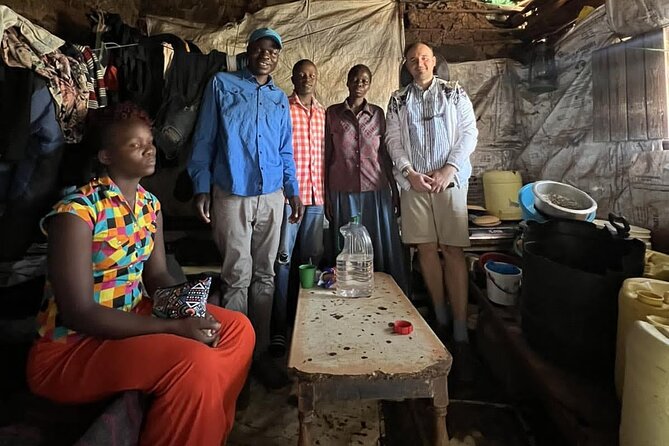
The home visit is likely to be the most personal part of the experience. You are welcomed into one of the local houses, where you can gain a better sense of domestic life than you can from walking past buildings.
The visit is not described as a long demonstration or staged performance. That is part of its value. You are offered a short window into a real home, with the local guide helping you understand the setting and the family’s welcome.
You should be especially careful here. Remove any assumption that a home visit gives you permission to photograph rooms, residents, or belongings. Ask before taking pictures, keep your voice low, and let the host set the pace.
This stop may also be uncomfortable for some people because living conditions can highlight differences between your own home and the homes you see. The right response is not pity or forced cheerfulness. Listen to the explanation, ask thoughtful questions, and remember that a home is a private place even when it is part of an organized visit.
Taking a break at the cafeteria

The cafeteria is the final planned stop, where you can rest, have a soft drink or local food, and hear more about Kibera. Bottled water or soda is included, and local food may be available as part of the stop.
I consider this a useful ending because it gives the tour a slower moment. After walking and taking in a lot of information, you have time to sit and continue the conversation with the guide.
Food details are not specified, so you should not book this expecting a full meal or a particular menu. Think of it as a short refreshment stop with a chance to ask follow-up questions.
This is also where the wider social work may make more sense. You can ask how tour income is used, how the school-fee assistance works, and how the nonprofit operates in Kibera and rural Kenya. The guides welcome people and organizations interested in partnerships, so the conversation can extend beyond the three-hour visit if you have a serious interest in supporting the work.
What the $25 price really covers

At $25 per person, this is a modestly priced half-day activity. The fee covers the guide-led visit, all fees and taxes, and bottled water or soda. It also helps fund the community program because half of the booking fee goes toward school fees for children in need.
That gives the price a practical social value. You are paying for time, local access, organization, and a direct community contribution, rather than simply buying a walk through a neighborhood.
Still, the value depends on your expectations. If you want a polished sightseeing route with major attractions, this is not the right product. If you want personal explanation, local introductions, and a better understanding of life in Kibera, the fee is easier to justify.
The tour is usually booked about 12 days ahead. That is useful planning information if your Nairobi schedule is fixed. I would reserve early rather than assume a last-minute place, especially since the group limit is 30 people and the experience has strong demand.
A three-hour pace and group size

The visit takes about three hours. That is long enough to cover the five stops without requiring you to give up an entire day of sightseeing.
The group can hold up to 30 people. A group that size can affect the feel of the walk, particularly during the home visit or when meeting children. You may have less personal conversation than you would in a private tour.
The provider says the experience is flexible and can be customized around your interests. You should raise those interests before or at the start of the tour, rather than expect every special request to happen automatically. You might ask for more time on crafts, community projects, education, or daily work, depending on what matters most to you.
Most people can participate, and service animals are allowed. The activity is near public transportation, but the supplied details do not specify a particular bus route or train connection. Use the stated meeting point at Prestige Plaza Shopping Mall and confirm the exact meeting instructions when booking.
The emotional side of a Kibera visit

This is a humbling activity, and that can be useful if you approach it properly. You may learn about resilience, limited resources, education costs, and the ways people support one another. The goal is not to leave feeling superior or guilty. It is to leave with a more accurate understanding.
The guides are described as welcoming, friendly, and willing to speak openly about difficult realities. That openness is one of the strongest reasons to choose this experience. A local resident can explain the difference between what you notice at first glance and what daily life actually means.
You should also expect moments that feel uncomfortable. The word slum carries a lot of baggage, and the community is larger and more complex than that label suggests. Listen to how residents describe their own lives, and avoid turning hardship into a story about your own personal transformation.
Bring a respectful attitude, practical clothing, and a willingness to follow instructions. The tour includes a home visit and meetings with children, so personal boundaries matter more here than on a standard city walk.
Community impact through OAC and KCOOP
OAC Kenya Tours describes itself as a social impact business. Half of the booking fee from this experience goes toward school fees for children in need in the community.
The wider work includes OAC Kenya Crafts and KCOOP Organization. KCOOP was officially established and registered in 2022, and it operates in Kibera as well as rural parts of Kenya. The organization shares regular updates through its website and social media, including the Instagram account @kcoop.organization.
This information lets you check the work for yourself and decide if the cause fits your values. I appreciate that the financial promise is specific rather than vague: 50 percent of the booking fees supports school fees.
You can also ask about partnership opportunities if you represent a school, company, nonprofit, or other group. The organization is seeking like-minded partners to help more children, though partnership is not part of the standard three-hour tour.
Booking, cancellations, and weather
You receive confirmation at the time of booking, and a mobile ticket is accepted. The activity starts and ends at Prestige Plaza Shopping Mall on Ngong Road.
Free cancellation is available if you cancel at least 24 hours before the start time. Cancellations made less than 24 hours before the start time are not refunded, and changes inside that window are not accepted.
The tour requires good weather. If poor weather causes cancellation, you are offered another date or a full refund. Keep that rule in mind when planning a tight Nairobi itinerary.
Who should book this Kibera tour
I would recommend this visit to you if you want direct contact with local guides, can listen without rushing, and are interested in how tourism can support a community program. It suits people who want more than a quick photograph and who are willing to handle sensitive subjects with care.
It is also a good choice if you value a clear social purpose. The school-fee contribution gives the $25 price a defined benefit, while the home, craft, and cafeteria stops keep the visit personal and grounded.
I would hesitate to recommend it if you dislike emotionally difficult settings, want a private experience, or expect a polished attraction with fixed performances. A group of up to 30 can feel less personal, and the realities of Kibera may be challenging to process.
Should you book it?
Book this tour if you want to meet Kibera through residents who live there and if supporting school fees is part of your travel budget. The strongest features are the local guides, the honest discussion of community life, and the specific 50 percent contribution.
Go with respect, ask before taking photographs, and let the guides explain the community in their own terms. If that sounds like the kind of Nairobi experience you are seeking, this is a thoughtful use of three hours and $25.
FAQ
How long does the Kibera Slum Tour with a Local last?
The experience lasts approximately three hours.
How much does the tour cost?
The tour costs $25 per person.
Where does the tour start and finish?
It starts at Prestige Plaza Shopping Mall on Ngong Road in Nairobi and ends back at the same meeting point.
What stops are included?
The tour includes the local office, a crafts center, a meeting with children, a local home visit, and a cafeteria stop.
Does the tour support the local community?
Yes. Fifty percent of the booking fees helps pay school fees for children in need in the Kibera community.
What is included in the price?
The price includes bottled water or soda, plus all fees and taxes.
Can I cancel the tour for a refund?
You can cancel for a full refund up to 24 hours before the experience starts. Cancellations made less than 24 hours before the start time are not refunded. If poor weather causes the provider to cancel, you are offered another date or a full refund.
Just added around Nairobi
- Visit kibera Slum the chocolate city★ 4.8 · 3 reviews
- 3 days maasai mara migration safari★ 4.5 · 7 reviews
- Maasai Mara Day Trip★ 5.0 · 15 reviews
- 4 Days Tour Landcruiser in Masai Mara and Lake Nakuru★ 5.0 · 10 reviews
- 4 Days Safari to Lake Nakuru N/P and Maasai Mara N/R★ 5.0 · 18 reviews
- Day Tour to Nairobi national park, Elephants, and Giraffe Center★ 3.5 · 8 reviews
- Wildebeest Migration in Masai Mara and Sightseeing 4 Days Tour★ 4.5 · 6 reviews
- Vegans special safari★ 4.5 · 4 reviews
Cultural Village Visits, compared.


Day Tour to Amboseli National Park & Maasai Village
Read our review →



Kibera Slum Tour with Local Social Entrepreneurs
Read our review →

Giraffe Centre, Elephant Orphanage, and Bomas of Kenya Day Tour from Nairobi
Read our review →Browse the lists this tour appears in